LATEST ARTICLES

Residency Rules: Income Tax Act, 1961 vs Income Tax Bill, 2025 — A Subtle Yet Significant Shift!

Residential status is one of the most critical factors in determining an individual’s tax exposure in India. For decades, Section 6 of the Income-tax Act, 1961 laid down clear and well-understood rules to decide whether a person qualifies as a Resident or Non-Resident.

With the proposed Income-tax Bill, 2025, while the overall framework remains intact, a subtle but important tightening has been introduced; one that individuals working overseas and tax professionals must not overlook.

What the law said earlier (Income-tax Act, 1961)-

Under Income Tax Act, 1961 an individual was treated as a “Resident” if they:

    • Stayed in India for 182 days or more in a year, or
    • Stayed for 60 days in the year and 365 days in the preceding four years

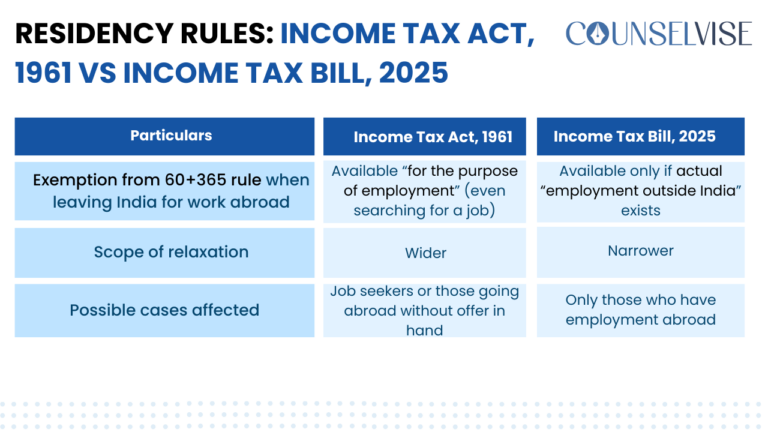
However, there was a significant relief. If an Indian citizen left India for the purpose of employment abroad, Explanation 1(b) under Section 6 of the Act ( i.e. the 60+365 day condition) did not apply.
In practice, this phrase was interpreted widely; covering even those who went abroad to explore or search for job opportunities.

What changes under the Income-tax Bill, 2025-

The proposed Bill narrows this relief.

The exemption from the 60+365 day rule now applies only when:

    • A person leaves India as a crew member of an Indian ship, or
    • Leaves India for actual employment outside India

The earlier, broader phrase “for the purpose of employment” has been consciously replaced. This linguistic shift materially raises the bar.

Why this matters in real life

    • Earlier, individuals going abroad without a confirmed job could still claim Non-Resident status.
    • Going forward, mere job hunting abroad may not suffice.
    • Without proof of overseas employment, individuals may end up being classified as Residents, triggering taxation of global income in India, and Increased reporting and compliance obligations.

Closing thoughts

What appears to be a minor drafting change is, in reality, a policy-driven tightening of residency norms. The objective is to prevent the misuse of Non-Resident status based solely on temporary overseas movement without substantive employment.

Professionals, NRIs, and consultants planning to move abroad for career opportunities should carefully evaluate this change and plan accordingly.

Transfer Pricing and International Tax Reforms under Finance Bill, 2026: A Practical Overview

In an increasingly volatile global economic environment, Budget 2026 reflects India’s conscious shift towards certainty, predictability, and long-term institutional strength in taxation. Rather than focusing on headline rate changes, the Budget makes targeted reforms in transfer pricing and international tax to reduce litigation, align tax rules with commercial reality, and enhance India’s credibility as a stable destination for cross-border investment.

1. Expanded and Simplified Safe Harbour Regime

Safe Harbour Rules play a critical role in reducing TP litigation by prescribing minimum margins that, if complied with, are accepted by the tax authorities without detailed scrutiny.

1.1 Unified Safe Harbour for Information Technology Services

The Finance Bill proposes to consolidate multiple inter-linked IT segments into a single category of “Information Technology Services”, covering:

    • Software development services,
    • IT-enabled services,
    • Knowledge Process Outsourcing (KPO),
    • Contract R&D services relating to software development.

Key Amendments-

CategoryProposed Change
IT Services (Software dev, ITES, KPO, Contract R&D – software)Unified safe harbour margin of 15.50%
Threshold for IT ServicesEnhanced from ₹300 crore to ₹2,000 crore
Approval mechanismAutomated, rule-based approval (no officer discretion)
Validity periodCan be applied for 5 consecutive years
Data Centre servicesSafe harbour of 15% mark-up on cost
Electronic goods warehousingSafe harbour of 2% of invoice value

2. Advance Pricing Agreements (APA): Wider Coverage and Faster Resolution

Advance Pricing Agreements remain one of the most effective tools for long-term TP certainty.

Key Amendments-

AspectProposed Amendment
Modified return filingExtended to Associated Enterprises (AEs)
Time limit for filing modified returnWithin 3 months from end of month of APA
ApplicabilityAPAs entered into from 1 April 2026 onwards
Unilateral APA (IT services)Target completion in 2 years (extendable by 6 months)

3. International Tax: Strategic Exemptions to Boost Investment

3.1 Exemption for Foreign Companies Procuring Data Centre Services

Foreign companies will be exempt from tax on income arising from procuring data centre services from a Specified Data Centre in India.

Key Conditions

Exemption available up to tax year ending 31 March 2047

Data center must be set up under an approved scheme, notified by CG, and must be owned and operated by an Indian company.

  • Foreign company must:
    • Not own or operate physical infrastructure,
    • Sell to Indian users only through an Indian reseller,
    • Maintain prescribed documentation.

3.2 Exemption for Capital Goods Supplied to Electronics Manufacturers

Foreign companies supplying: Capital goods, Equipment and Tooling to Indian contract manufacturers operating from custom bonded warehouses will enjoy tax exemption on such income.

Key Conditions

    • Ownership remains with the foreign company,
    • Contract manufacturer operates under control and direction,
    • Applicable from AY 2027-28 to AY 2031-32.

4. Foreign Assets of Small Taxpayers Disclosure Scheme, 2026

Recognising genuine compliance challenges faced by small taxpayers, a one-time disclosure window is proposed.

4.1. Eligibility & Scope

CategoryCovered Persons
ResidentsResidents in relevant previous year
Non-residents / NORIf resident when asset was acquired or income earned
Target groupStudents, young professionals, tech employees, relocated NRIs

4.2. Tax / Fee Structure

Type of Asset / IncomeAmount Payable
Undisclosed foreign asset / income (≤ ₹1 crore)30% tax + 100% penalty
Asset acquired as non-resident, not disclosed (≤ ₹5 crore)₹1 lakh fee

4.3. Immunity & Safeguards

AspectBenefit Provided
PenaltyComplete immunity
ProsecutionComplete immunity
ReassessmentNo reopening of completed assessments
ExclusionsProceeds of crime, PMLA cases, completed Black Money Act cases

5. Strategic Impact of TP and International Tax Reforms

    • Certainty over Disputes: Expanded safe harbours and faster APAs materially reduce cross-border tax risk.
    • Targeted Growth Focus: Tax relief aligned with data centres, electronics, and GCC-led investment.
    • Systemic Simplification: Standardization and automation signal a shift from litigation to predictability.

Minimum Alternate Tax (MAT): Comprehensive Overview and Key Changes under Finance Bill, 2026

Minimum Alternate Tax (MAT) has long been a cornerstone of India’s corporate tax framework, designed to ensure that companies reporting substantial book profits do not entirely avoid tax liability through exemptions and incentives. Over the years, MAT has evolved to balance revenue considerations with taxpayer certainty.

The Finance Bill, 2026 introduces significant structural changes to MAT, impacting tax rates, credit utilisation, regime choice, and applicability for specific categories of taxpayers.

1. What is Minimum Alternate Tax (MAT)?

Minimum Alternate Tax is a mechanism under section 115JB of the Income-tax Act that requires companies to pay a minimum level of tax on their book profits, even if their tax liability under the normal provisions is lower.

In simple terms:

  • If normal tax > MAT → normal tax applies
  • If MAT > normal tax → MAT applies

MAT ensures that companies benefiting from deductions, incentives, or exemptions still contribute a minimum amount to the tax exchequer.

2. Applicability of MAT

MAT is applicable to:

  • Domestic companies
  • Foreign companies (wherever MAT provisions apply)

MAT is generally not applicable to:

  • Companies opting for certain presumptive taxation regimes
  • Specific non-resident categories, as clarified in recent amendments

3. MAT Rate: Key Change under Finance Bill, 2026

Revised MAT Rate

The Finance Bill, 2026 proposes to reduce the MAT rate:

ParticularsEarlier RateProposed Rate
MAT on book profits15%14%
Effective from Tax Year 2026-27 (AY 2027-28 onwards)

4. MAT Credit: Concept Explained Simply

When a company pays MAT instead of normal tax:

  • The excess MAT paid over normal tax becomes MAT credit
  • This credit can be carried forward and set off against future normal tax liability (subject to conditions)

MAT credit helps ensure that MAT does not become a permanent tax cost where a company later becomes taxable under normal provisions.

5. MAT Treatment for Companies under Old vs New Tax Regime

MAT Treatment: Old Regime vs New Regime (As per Finance Bill, 2026)

Companies under Old RegimeCompanies under New Regime
MAT paid shall be treated as final taxCompanies opting for the new regime from tax year 2026-27 or subsequent years will be eligible to set off MAT credit accumulated up to 31 March 2026
MAT credit cannot be carried forwardMAT credit can be set off to the extent of 25% of tax liability for each tax year
MAT credit accumulated up to 31 March 2026 shall expire and will not be eligible for carry forward thereafterSuch MAT credit shall be allowed to be carried forward and utilised for a period of 15 years
No new MAT credit shall be allowed in respect of tax paid at 14% from 1 April 2026MAT credit is restricted only to credit generated up to 31 March 2026

6. MAT Credit for Foreign Companies

For foreign companies (where MAT applies):

  • MAT credit can be carried forward and utilised to the extent normal tax exceeds MAT
  • This aligns MAT principles for foreign companies with global tax equity norms

7. Specific Exclusions from MAT Applicability

The Finance Bill, 2026 proposes to exclude MAT applicability for certain non-residents, including:

  • Non-residents engaged in cruise ship operations
  • Non-residents providing services or technology for setting up an electronics manufacturing facility in India, where the resident company opts for presumptive taxation

8. Strategic Impact of MAT Amendments- Core Insights

  1. Recharacterization of MAT from Timing Difference to Tax Cost– The decision to treat MAT as final tax and discontinue the generation of new MAT credit fundamentally alters its character; from a temporary timing difference to a definitive tax incidence. This shift compels businesses to reassess MAT not as a recoverable advance tax, but as a permanent charge impacting economic returns.
  2. Elevation of Regime Selection to a Structural Tax Choice– The bifurcation of MAT treatment under the old and new regimes transforms regime selection into a structural decision with long-term consequences. Companies must now evaluate regime choice through the lens of sustainability, capital efficiency, and predictability rather than short-term tax optimization.
  3. Institutionalization of Certainty and Decline in Legacy Complexity– By curtailing MAT credit accumulation and prescribing clear utilization limits, the amendments institutionalize certainty while progressively dismantling legacy tax complexity. This is likely to reduce protracted disputes, simplify deferred tax positions, and enhance the credibility of financial reporting for stakeholders.

Finance Bill, 2026: Key Direct Tax Amendments on Assessments and Appeals

The Finance Bill, 2026 introduces important refinements to the direct tax regime with a clear focus on easing compliance and reducing avoidable disputes. These changes are designed to offer taxpayers greater clarity, flexibility, and confidence while navigating income-tax procedures.

1. Updated Return: Expanded Scope and Greater Flexibility for Taxpayers

Current Position
Under the existing provisions, an updated return cannot be filed if it results in a loss declaration, nor can it be filed after the initiation of reassessment proceedings.

Proposed Amendments
The Finance Bill, 2026 significantly expands the scope of filing updated returns by allowing taxpayers to:

    • File an updated return where the quantum of loss is reduced compared to the original return,
    • File an updated return even after receipt of a reassessment notice, provided it is filed within the time specified in such notice.

Additional Tax Implications

    • In cases where an updated return is filed after issuance of a reassessment notice, an additional 10% tax will be levied over and above the existing additional tax,
    • For example, where the additional tax was earlier 25%, the total additional tax would increase to 35%.

Key Relief

  • Income disclosed in such updated returns will not be subject to penalty for under-reporting or mis-reporting of income.

2. Time Limit for Assessments under DRP Route Clarified

A long-standing controversy existed regarding whether DRP timelines are included within, or in addition to the assessment time limits under section 153.

Finance Bill Clarification

    • Section 153 applies to issuance of draft assessment order
    • Section 144C (DRP) timelines apply for finalisation of assessment; DRP timelines operate over and above section 153.

Section 153 Timeline
|————————-|
Assessment → Draft Order

            Section 144C (DRP) Timeline
            |---------------------------|
            DRP Proceedings → Final Order

3. Jurisdiction for Issuing Reassessment Notices (Sections 148 & 148A)

Existing Issue

Conflicting High Court rulings on whether Jurisdictional AO, or NFAC / Faceless AO should issue reassessment notices in international and central charge cases.

Proposed Clarification

  • Only the Jurisdictional Assessing Officer can issue notices and conduct proceedings under sections 148 and 148A.

4. Clarification on Time Limit for Transfer Pricing Orders

Issue

There was ambiguity on how to compute the 60-day period available to the TPO for passing TP orders.

Proposed Solution (As per IT Act, 2025)

Assessment Limitation ends onLast Date to pass TP Order
31st March of any year31 January of that year
31st December of any year31 October of that year

Applicability:
Retrospective from 1 June 2007 under IT Act, 1961
From 1 April 2026 under IT Act, 2025

5. Clarification on Document Identification Number (DIN)

Proposed Amendment

Assessment orders will not be invalidated merely due to Mistake, defect, or omission in quoting DIN as long as the order is referenced by DIN in any manner.

Effective Date

  • Intended to apply retrospectively from 1 October 2019.

Conclusion

The Finance Bill, 2026 marks a decisive step towards bringing clarity and certainty to the assessment and appeals framework under direct tax laws.

Budget 2026: 5 Major Personal Tax Changes Every Taxpayer Must Know

Union Budget 2026 introduces targeted reforms aimed at easing compliance, reducing litigation, and rationalizing personal taxation. While tax rates remain unchanged, several structural and procedural changes will significantly impact individual taxpayers, investors, and high-net-worth individuals.

1. More Time to File and Revise Your Income Tax Return

What’s changed?
The Government has extended timelines for filing and revising income tax returns to provide greater flexibility and reduce unintentional defaults.

Key Highlights

    • Revised Return Deadline extended from 31 December to 31 March,
    • Late fee applicable if filed after 31 December,
    • Due date for non-audit cases (businesses & trusts) shifted from 31 July to 31 August.

Why it matters

✔ More time for accurate reporting
✔ Reduced need for rectification and litigation

2. Relief for Foreign Asset Disclosures (FAST-DS 2026)

A major compliance relief for small and genuine taxpayers holding foreign assets.

What’s new?

    • No prosecution for non-disclosure of non-immovable foreign assets; applicable where aggregate value is below ₹20 lakh,
    • Retrospective effect from 1 October 2024.

Impact

✔ Relief from harsh prosecution provisions
✔ Encourages voluntary compliance

3. TCS Cuts on Foreign Spending and Outward Remittances

Budget 2026 rationalises Tax Collected at Source (TCS) to reduce cash-flow pressure on individuals.

Revised TCS Rates

    • Overseas tour packages: Reduced to 2%
    • Outward remittances for education & medical treatment: Reduced from 5% to 2%

Who benefits?

✔ Students studying abroad
✔ Families funding overseas education or healthcare
✔ Individuals planning foreign travel

4. Buyback Taxation Shifted to Capital Gains in Shareholders’ Hands

A significant structural change impacting investors and promoters.

What’s changed?

    • Buyback proceeds will now be taxed as capital gains in the hands of shareholders,
    • Moves away from the earlier dividend-style taxation
    • Applicable to buybacks on or after 1 April 2026

Why this matters

✔ Aligns buyback taxation with global practices
✔ Enhances transparency
✔ Impacts high-value and promoter-driven buybacks

5. Sovereign Gold Bonds (SGBs): Exemption Narrowed

Tax exemption on Sovereign Gold Bonds is now more targeted.

New Rules

    • Capital gains exemption at redemption retained only for original subscribers,
    • Secondary market buyers will be taxed on gains at applicable capital gains rates,
    • Applicable from 1 April 2026

Impact

✔ Protects long-term original investors
✔ Removes arbitrage benefits for secondary buyers

Conclusion: A Taxpayer-Friendly Yet Disciplined Approach

Budget 2026 does not overhaul tax rates but refines the personal tax framework through:

    • Procedural ease,
    • Reduced litigation,
    • Rationalised compliance,
    • Better alignment with economic realities.

For taxpayers, investors, and professionals, early planning is key to maximising benefits under the new regime.

Finance Bill, 2026: Key GST Reforms that will Reshape Compliance and Cash Flows

The Finance Bill, 2026 introduces a series of targeted yet impactful amendments to the GST and indirect tax framework, with a clear policy focus on compliance simplification, liquidity support, and ease of doing business.

1. Post-Sale Discounts: Long-Awaited Clarity Arrives

🔹 What was the issue?

Under Section 15(3)(b) of the CGST Act, post-supply discounts were excluded from taxable value only if they were pre-agreed at or before supply and linked to specific invoices. This rigid requirement resulted in frequent disputes and denial of tax benefits for commercial, post-sale incentive structures.

🔹 What is proposed?

    • Removal of the requirement that post-sale discounts must be pre-agreed.
    • Post-sale discounts can now be excluded from taxable value when a credit note is issued, subject to reversal of proportionate ITC by the recipient.
    • Section 34 is proposed to be amended to explicitly recognize post-sale discounts as a valid ground for issuing credit notes.

🔹 Impact

✔ Reduced litigation
✔ Alignment of GST law with business realities

2. Provisional Refunds Extended to Inverted Duty Structure (IDS)

🔹 Current position

Provisional refund of up to 90% under Section 54(6) was available only for zero-rated supplies, leaving IDS taxpayers facing prolonged refund delays.

🔹 Proposed amendment

    • Provisional refund mechanism to be extended to refunds arising from inverted duty structure.
    • Up to 90% of the refund amount to be released upfront, subject to risk-based checks.

🔹 Impact

✔ Significant liquidity relief
✔ Reduced refund pendency

This marks a major policy shift in favor of manufacturing and domestic supply chains.

3. Removal of ₹1,000 Threshold for Export Refunds

🔹 The problem

Section 54(14) restricted refunds below ₹1,000 per tax head, disproportionately affecting:

    • Small exporters
    • E-commerce sellers
    • Courier and postal exports

🔹 What changes?

  • Refunds on exports with payment of tax will be excluded from the ₹1,000 minimum threshold.

🔹 Why it matters

✔ Encourages MSME and cross-border e-commerce exports
✔ Aligns India with international best practices
✔ Improves cash flow predictability for exporters

4. Faster Resolution of Conflicting Advance Rulings

🔹 Background

Although the CGST Act provides for a National Appellate Authority (NAA), it has not been constituted, leading to delays where conflicting rulings arise across States.

🔹 Proposed solution

    • Insertion of Section 101A(1A) empowering existing authorities (including tribunals) to act as the NAA from 1st April 2026.
    • Ensures uninterrupted appellate mechanism until a formal NAA is constituted.

🔹 Impact

✔ Reduced jurisdictional conflicts
✔ Faster dispute resolution

5. Intermediary Services: Major Relief for Export of Services

🔹 Existing challenge

Section 13(8)(b) of the IGST Act deemed the place of supply for intermediary services as the location of the supplier, effectively denying export status even when services were provided to foreign clients.

🔹 Proposed reform

    • Omission of Section 13(8)(b).
    • Place of supply to be determined under the general rule (Section 13(2)), i.e., location of the recipient.

🔹 Impact

✔ Intermediary services can qualify as exports
✔ Zero-rated benefits restored
✔ Indian service providers become globally competitive

This is one of the most industry-welcomed amendments in recent years.

Concluding Thoughts

The Finance Bill, 2026 reflects a maturing GST regime, where policy intent is clearly shifting from strict interpretation to practical facilitation. By resolving legacy issues around discounts, refunds, exports, and intermediary services, the government has sent a strong signal of its commitment to certainty, liquidity, and business growth.

From Endless Revisions to Timely Compliance: The New Era of TDS/TCS Rectification

A Paradigm Shift Towards Disciplined Tax Compliance

In India’s evolving tax ecosystem, TDS and TCS compliance has moved from being merely procedural to becoming time-bound and accountability-driven. One of the most significant recent changes is the introduction of statutory time limits for rectification of TDS/TCS statements marking a decisive shift from unlimited corrections to structured compliance.

The Old Reality: No Time Limit, Endless Revisions-

Traditionally, while original TDS/TCS returns had specific due dates, there was no statutory deadline for submitting correction statements.

Why was this change needed?

The absence of a time limit led to several practical challenges:

    • Multiple corrections filed long after the relevant financial year
    • Continuous mismatch between Form 26AS / AIS and returns
    • Administrative burden on the tax department
    • Deductees facing delayed credits and avoidable notices

Legislative Evolution of time limits

PhaseAmendmentTime Limit Introduced
Phase 1Finance (No. 2) Act, 2024Corrections allowed up to 6 years from end of FY
Phase 2Income Tax Act, 2025Time limit reduced to 2 years from end of FY in which statement was due

One-Time Transition Window

To help taxpayers clean up legacy issues, a final transition window has been provided.

Period CoveredLast Date to File Correction
FY 2018-19 (Q4) to FY 2023-24 (Q3)31 March 2026
Post 31 March 2026, corrections for these periods will be time-barred, regardless of the reason.

A Broader Shift in Compliance Philosophy

This reform is not just procedural — it reflects a policy shift towards certainty, discipline, and finality. The tax administration is moving away from endless rectifications and encouraging:

Accurate reporting at the first instance rather than perpetual corrections.

Revisionary Powers under the Black Money Act

The Black Money Act is meant to be strict.
But even strict laws have limits.

The core issue

Can the tax department reopen a concluded assessment under the Black Money Act simply because it now holds a different view?

The Background

• A foreign trust was settled in 1990 by the assessee’s father, naming the assessee as a beneficiary,
• The assessee became aware of the trust post 2006,
• A voluntary disclosure under Section 59 was filed on enactment of the BM Act, declaring ₹8.55 crore,
• Assessment was completed under Section 10, accepting the disclosure.

What triggered revision

Years later, the Department invoked Section 23, alleging:

• Historical trust distributions prior to 2006,
• Undisclosed foreign assets and bank accounts,
• Assessment being erroneous and prejudicial to revenue.

The foundation? Trust minutes—without evidence of actual receipt.

What the Tribunal held

1. Section 23 is not a review power

Revision under Section 23 was initiated on the same material already considered.

Such action amounted to a mere change of opinion.

Section 23 does not permit review or re-appreciation of evidence.

2. No Error in the Original Assessment

    • The assessee categorically denied receipt of any trust distributions.
    • The issue was specifically examined during the original assessment.
    • The Assessing Officer took a conscious and plausible view after inquiry.

3. Absence of Corroborative Financial Evidence

    • The Department failed to produce bank statements or transaction trails.
    • No proof existed to show actual receipt or control by the assessee.
    • Allegations without financial evidence cannot sustain revision.

4. Trust Minutes Lacked Evidentiary Value

    • The minutes were recorded after the death of the settlor.
    • The assessee had no involvement in the alleged decisions.
    • Mere internal trust records cannot establish receipt of income.

Key Takeaways

    • Section 23 is not a review or reassessment provision.
    • Completed assessments cannot be revised on mere suspicion or change of opinion.
    • Discretionary trust beneficiaries are taxable only on real income.
    • Accepted disclosures under Section 59 attain finality.
    • Income or assets must be taxed in the correct assessment year.

Bottom line

The Black Money Act is a powerful law—but not an unlimited one.

Once disclosure is accepted and assessment is completed after due inquiry,
the chapter must close.

Law laid down for S.263 of IT Act on revision of assessment order equally applies to S.23 of BM Act as language of both the sections are pari materia.

This ruling sends a clear message:
Enforcement cannot replace evidence, and revision cannot replace review.

In the case of Shefali Chintan Parikh, ITAT Ahmedabad bench [BMA No. 2/Ahd/2025]

Rule 31D under GST: MRP-Based Valuation Explained (Effective 1 February 2026)

The GST valuation framework has witnessed a significant shift with the insertion of Rule 31D of the CGST Rules, 2017, notified vide Notification No. 20/2025 – Central Tax dated 31 December 2025, effective from 1 February 2026.

This rule introduces MRP based valuation for specified goods, overriding the conventional transaction value mechanism and addressing long-standing concerns around undervaluation and tax leakage.

1. Legal Background and Objective

Under GST, the general principle is that tax is levied on the transaction value as per Section 15 of the CGST Act, 2017. However, certain goods particularly pan masala, tobacco products, cigarettes and similar items were frequently found to be undervalued at the supply stage, leading to:

    • Suppression of output tax,
    • Excess and unjustified input tax credit (ITC) claims,
    • Revenue leakage to the exchequer.

To curb these practices, Rule 31D has been introduced with an overriding effect to ensure GST is discharged on a more reliable and transparent value base.

2. Overriding Nature of Rule 31D

Rule 31D begins with a non-obstante clause (“Notwithstanding anything contained…”), thereby overriding:

    • Section 15 of the CGST Act, 2017
    • Rules 27 to 31C of the CGST Rules, 2017

Accordingly, for specified goods, GST valuation will no longer depend on the invoice value, even if the transaction price is lower.

3. Valuation Mechanism under Rule 31D

For goods notified under Rule 31D, the value of supply shall be determined as:

Retail Sale Price (MRP/RSP) printed on the package,
(Less): the GST included in such price

GST Extraction Formula:

GST Amount=Retail Sale Price × GST Rate​/100 + GST Rate

4. Key Explanation Clauses under Rule 31D

Rule 31D contains detailed explanations to remove ambiguity:

    • Applicable Tax includes CGST, SGST, UTGST or IGST, as the case may be,
    • Retail Sale Price (RSP) means the maximum price at which goods may be sold and includes all taxes, cess, surcharge and duties,
    • Multiple MRPs on the same package: The highest MRP shall be adopted,
    • Subsequent increase in MRP: The revised higher MRP becomes the valuation base, even if increased after supply,
    • Area-wise MRPs: Valuation will be based on the MRP applicable to that specific area only.

5. Specified Goods Covered

Rule 31D applies to notified high-risk goods, including:

    • Pan masala,
    • Tobacco,
    • Cigarettes,
    • Cheroots and similar tobacco products.

6. Amendment to Rule 86B – Cash Payment Relief

General Rule

Under Rule 86B, certain registered persons are required to discharge at least 1% of output GST liability in cash, even if sufficient ITC is available.

Relaxation Introduced

For traders (non-manufacturers) dealing in goods covered under Rule 31D:

    • The 1% mandatory cash payment requirement will not apply
    • Condition: The supplier must have paid GST on MRP (RSP) basis

Since GST is already discharged on the maximum retail price at the first stage, the risk of undervaluation and ITC misuse addressed by Rule 86B does not arise.

7. Illustrative Case Study

Facts
A manufacturer supplies packaged cigars (HSN 2402) with a printed MRP of ₹1,280, but invoices the distributor at ₹900. The applicable GST rate is 28%.

Tax Treatment
Since cigars are covered under Rule 31D:

    • GST must be charged on MRP (₹1,280), not invoice value of ₹900
    • GST payable = (1,280 × 28) / 128 = ₹280
    • Taxable value (excluding GST) = ₹1,000

GST of ₹280 is payable despite the lower transaction price.

Rule 86B Impact
The distributor is not required to pay 1% GST in cash, as the supplier has already discharged GST on MRP basis.

8. Practical Impact at a Glance

Manufacturers:
MRP fixation becomes critical, as GST is payable on MRP irrespective of discounts. Systems and pricing controls may need updates.

Traders:
Relief from Rule 86B’s 1% cash payment, subject to confirmation that the supplier has discharged GST on MRP basis.

Auditors & Professionals:
Focus shifts to verification of MRP declarations, correct GST extraction, and proper documentation for Rule 86B relaxation.

Section 54 is about Intent, Not Brick-by-Brick Completion

Tax law often forgets one thing: real life doesn’t move at the speed of statutes.
Construction approvals get delayed. Plans change. Timelines slip.

The Kolkata Bench of the ITAT has now reaffirmed this reality in a welcome ruling under Section 54 of the Income-tax Act.


The Story in Brief:

The assessee, Ramautar Saraf (HUF), sold a residential house property during FY 2015-16 for a consideration of ₹6.25 crore, resulting in long-term capital gains of ₹5.48 crore.

Against this capital gain, the assessee claimed exemption under Section 54, on the basis that the gains were invested in:

    • Purchase of land for construction of a residential house,
    • Architect fees,
    • Deposit in the Capital Gains Account Scheme (CGAS).

After claiming exemption, only ₹1.88 lakh was offered to tax as taxable LTCG.

Yet, despite genuine investment and commencement of construction, the exemption was denied.

Why?
Because the house was not fully constructed within three years.


Why the Tax Authorities Said “No”?

The Assessing Officer — and later the CIT(A) — took a strict view:

    • Construction was not completed within three years,
    • Municipal approval came after the statutory deadline,
  • Therefore, the conditions of Section 54 were allegedly violated.

In essence, delay equalled disqualification.


Issue Before the ITAT:

Whether exemption under Section 54 can be denied merely because construction of the residential house was not completed within three years, despite the capital gains having been invested within the prescribed period?


What the ITAT Looked at:

The Tribunal shifted the focus from paperwork to purpose.

It asked a simple but powerful question:

Did the taxpayer genuinely reinvest the capital gains into a residential house?

The answer was clearly yes.

The ITAT held that:

(a) Section 54 is a Beneficial Provision

The Tribunal reiterated that Section 54 is a beneficial provision and must be interpreted liberally.

(b) Completion of Construction is Not Mandatory

The law does not require completion of construction within three years. What is material is:

  • Utilization of capital gains for construction within the stipulated period; not whether the house is fully completed or habitable.

(c) Investment in Land is part of Construction

Purchase of land for the purpose of constructing a residential house qualifies as eligible investment under Section 54.

The Tribunal noted that the assessee had:

    • Paid ₹2.80 crore for purchase of land,
    • Incurred architect fees,
    • Started construction within the three-year window,
    • Deposited unutilized amounts in CGAS.

These actions satisfied the statutory requirements.


A Crucial Timing Insight:

One of the most practical takeaways from the ruling is this:

The question of whether construction was ultimately completed does not arise in the year of transfer.

That examination can happen only after the three-year window expires, and even then, only to the extent funds remain unutilized.

Denying the exemption prematurely, as done in this case, was held to be legally flawed.


Judicial Consistency, Not Judicial Sympathy:

This wasn’t an emotional decision — it was a legally consistent one.

The ITAT relied on well-settled principles laid down by:

    • Supreme Court in Fibre Boards
    • Multiple ITAT benches across India

The consistent message:
“Utilization” is the key word in Section 54 — not “completion.”


Final Verdict:

    • Disallowance of ₹2.86 crore under Section 54 was deleted,
    • Order of the CIT(A) was set aside,
    • Appeal of the assessee was allowed in full.

Practical Takeaways for Taxpayers:

✔ Section 54 exemption cannot be denied solely due to incomplete construction,
✔ Completion of construction is not a condition precedent,
✔ Timing of assessment matters, premature denial is unsustainable.


Closing Thought:

The ruling reinforces a well-settled but frequently litigated principle:
Section 54 rewards intention and investment, not mere completion.