LATEST ARTICLES

8 Completely Legal Tax-Free Incomes in India (Valid Even Under the New Tax Regime)

In a system where most deductions are removed under the new tax regime, one thing still remains powerful incomes that are inherently tax-free.

These are not loopholes or aggressive tax strategies, but explicit exemptions under the Income Tax Act, 1961 that continue to benefit taxpayers regardless of the regime chosen.

1. Agricultural Income (Section 10(1))

Overview:
Income derived from agricultural activities is fully exempt from tax.

Key Points:

    • Land must be situated in India,
    • Includes cultivation, rent, and sale of produce,
    • May affect tax rate via partial integration.

2. Gifts from Specified Relatives

Overview:
Gifts received from defined relatives are completely tax-free.

Key Points:

    • Includes spouse, parents, siblings, lineal ascendants/descendants,
    • No upper limit,
    • Gifts from non-relatives > ₹50,000 are taxable.

3. Life Insurance Maturity Proceeds (Section 10(10D))

Overview:
Maturity proceeds are tax-free subject to conditions.

Key Points:

    • Premium ≤ 10% of sum assured,
    • High-value policies/ULIPs may be taxable,
    • Death benefit always exempt.

4. Provident Fund Withdrawals (EPF / PPF)

Overview:
PF withdrawals and interest enjoy tax exemption.

Key Points:

    • EPF tax-free after 5 years of service,
    • PPF fully exempt (EEE status),
    • Interest exemption subject to limits.

5. Scholarships for Education

Overview:
Scholarships are fully exempt from tax.

Key Points:

    • No monetary limit,
    • Must be for educational purposes,
    • Includes stipends and grants.

6. Interest from Tax-Free Bonds

Overview:
Interest earned on specified government-backed bonds is exempt.

Key Points:

    • Issued by entities like NHAI, REC, PFC,
    • Interest fully tax-free,
    • Capital gains taxable on sale.

7. Income Received from HUF

Overview:
Income distributed from HUF is tax-free in the hands of members.

Key Points:

    • HUF taxed separately,
    • No double taxation on distribution,
    • Useful for family tax structuring.

8. Long-Term Capital Gains on Equity (Section 112A)

Overview:
LTCG on listed shares and equity mutual funds enjoys partial exemption.

Key Points:

    • Gains up to ₹1.25 lakh per year are tax-free,
    • Excess taxed at 10%,
    • STT payment required.

Final Thoughts

Tax-free income isn’t about loopholes; it’s about smart financial planning within the law. By understanding these provisions, you can:

    • Reduce your tax burden legally,
    • Structure your income efficiently,
    • Build long-term wealth.

When Cash Beats Value: The Hidden Rule Driving India’s Biggest Insolvency Battle

In the world of Indian conglomerates where ambition meets capital and scale defines power a new corporate drama is unfolding. One that reads less like a boardroom transaction and more like a courtroom thriller.

At its core lies a deceptively simple question:

What truly defines value money promised, or money delivered?


The Prize: A Sleeping Giant

Jaiprakash Associates Ltd is no ordinary distressed asset.

Spanning nearly 4,000 acres across Noida and the Yamuna Expressway, it represents a vast portfolio of real estate, cement operations, hospitality assets, and marquee developments like Jaypee Greens and the International Sports City.

Once a symbol of India’s infrastructure ambitions, it now sits at the center of one of the most consequential insolvency battles in recent memory.


The Titans: Vedanta vs Adani

Two industrial heavyweights have stepped into the arena:

    • Vedanta Ltd, led by Anil Agarwal
    • Adani Group, led by Gautam Adani

What began as a structured bidding process has now escalated into a high-stakes legal confrontation one that could redefine the rules of India’s insolvency framework.


The Twist: When the Higher Bid Loses

Vedanta’s contention is both straightforward and disruptive.

It claims to have offered:

    • ~₹3,400 crore more in total value,
    • ~₹500 crore more in net present value.

Yet, lenders approved Adani’s ₹14,543 crore resolution plan.

This wasn’t a financial anomaly.
It was a deliberate choice.


The Hidden Metric: Certainty Over Size

Adani’s proposal brought something Vedanta’s did not:

    • Faster capital recovery (~2 years vs up to 5 years)
    • A stronger upfront cash component
    • Lower execution risk

In distressed investing, these factors introduce what can be called a “certainty premium.”

₹1 today can be worth more than ₹1.50 tomorrow- if tomorrow is uncertain.

This is the invisible metric that appears to have guided creditor decision-making.


The Legal Fault Line

Under India’s insolvency framework, value maximization is key.
But Vedanta Ltd argues its superior bid was not fairly considered, raising concerns round transparency and process.

The core question emerges:

Can a lower bid win purely because it is faster and more reliable?


From Tribunals to the Supreme Court

The case has moved through:

  • o National Company Law Tribunal- NCLT
  • o National Company Law Appellate Tribunal- NCLAT

Both upheld the lenders’ decision, citing “commercial wisdom.”

Now, the matter rests with the Supreme Court of India where the implications extend far beyond a single deal.


Why It Matters

This case could reshape how India evaluates distressed assets:

    • A Vedanta win may push focus toward higher headline value
    • An Adani win reinforces speed and certainty as decisive factors

Either way, it signals a deeper shift in India’s financial system.


Final Insight

This isn’t just a battle for an asset; it’s a battle over how value is defined.

Because in today’s financial reality:

Winning isn’t about bidding higher it’s about delivering sooner, and with certainty.


Closing Line

In the end, the fiercest corporate battles aren’t fought over assets;
they’re fought over the meaning of value.

When a Solar Inverter Went to Court… and Won a 5% GST Battle

What if a simple device sitting quietly in your solar setup, your inverter; became the center of a ₹120 crore tax dispute?

That’s exactly what happened in a landmark case before the Karnataka High Court. And the outcome? A ruling that could reshape how the renewable energy sector looks at GST.


The Real Question: Gadget or Lifeline?

At the heart of the dispute was a deceptively simple question:

Is a solar inverter just another electrical product… or is it the beating heart of a solar power system?

The taxpayer argued:

  • “This inverter is part of a solar power generating system → tax it at 5%.”

The department countered:

  • “It’s just electrical equipment → tax it at 18%.”

A difference of 13%, but with consequences running into crores.


What Makes an Inverter So Important?

Let’s simplify this.

Solar panels generate DC power.
But your home, office, and appliances run on AC power.

Enter the inverter- the silent transformer that makes solar energy usable; by converting DC into AC power.

No inverter = No usable electricity.

The Court picked up on this reality and asked a crucial question:

Can a solar system even function without an inverter?

The answer was obvious.


The Court’s Approach: Common Sense Over Complexity

Instead of getting lost in technical classifications and HSN codes, the Court took a practical, real-world view:

    • A solar system is not one product—it’s a combination of interconnected parts
    • Every component has a role—but some are indispensable
    • And the inverter? It’s not optional—it’s essential

The Court essentially said:

“If it walks like a part of a solar system and works like one, we will treat it as one.”


The Verdict: Big Relief for the Industry

The Karnataka High Court ruled clearly:

    • Solar inverters are integral parts of a solar power generating system,
    • They qualify for the concessional GST rate of 5%,
    • They cannot be taxed as standalone electrical equipment at 18%.

And just like that, a massive tax demand collapsed.


Few Powerful Takeaways

1. Function Matters More Than Labels-

It’s not about what a product “can be“; it’s about what it “actually does“.


2. You Don’t Need to Prove the End-Use Every Time-

If documents show the inverter is meant for solar systems, that’s enough.


3. Circulars ≠ Law-

The Court made it clear:
Government circulars cannot override official GST notifications.


Why This Judgment Is Bigger Than It Looks

This isn’t just about one company or one product.

It’s about:

    • Reducing unnecessary tax disputes,
    • Encouraging renewable energy adoption,
    • Bringing clarity where confusion existed for years.

And most importantly

“It reinforces that law should align with real-world functionality, not rigid interpretation.”


Final Thought: A Win for Logic

This judgment sends a strong message:

“Tax laws shouldn’t ignore how things actually work.”

By recognizing the inverter as the lifeline of a solar system, the Court didn’t just decide a tax rate; it backed a practical, sensible, and future-forward approach.

And for the solar industry?

That’s a bright outcome in every sense.

Delayed ITR Verification and Denial of Section 80P Deduction: A Critical Analysis of ITAT’s Ruling

The ITAT Bangalore, has once again addressed a recurring procedural issue with significant substantive consequences; whether a delay in verification of the ITR can justify denial of deduction under Section 80P.

This ruling carries particular importance for cooperative societies, which frequently rely on Section 80P benefits and often face procedural hurdles in compliance.

Background of the case-

The assessee, a cooperative society eligible for deduction under Section 80P of the Income Tax Act, filed its return of income within the prescribed due date. However, the return was not verified within the stipulated time under the Act.

The CPC, while processing the return under Section 143(1), treated the return as invalid due to delayed verification and consequently denied the deduction claimed under Section 80P.

The assessee later completed the verification process, but the delay triggered adverse consequences, leading to litigation.

Core issue for Consideration-

The central question before the ITAT was:

Can a procedural lapse such as delayed ITR verification result in denial of a substantive deduction under Section 80P, especially when the return was otherwise filed within the due date?

Integrated Legal Analysis with ITAT’s Findings

1. Section 139 & Rule 12: Filing and Verification of Return

Under Section 139, a return of income must be duly filed and verified. Rule 12 prescribes the manner and timeline for such verification, including e-verification requirements.

ITAT’s Interpretation:
The Tribunal acknowledged that verification is a statutory requirement and that a return becomes complete only upon verification. However, it emphasized that:

    • A delay in verification is a procedural defect, not a substantive illegality.
    • Once verification is completed, the return relates back to the original date of filing.

Thus, the ITAT effectively harmonized procedural compliance with practical realities, holding that delayed verification does not permanently invalidate the return.


2. Section 143(1): Scope of Processing and Adjustments

Section 143(1) allows for prima facie adjustments during automated processing of returns.

ITAT’s Interpretation:
The Tribunal strongly cautioned against mechanical application of this provision:

    • CPC’s automated system treated the return as invalid without considering subsequent verification.
    • The ITAT held that Section 143(1) cannot be used to deny legitimate claims based on curable procedural defects.
    • Adjustments must remain within the scope of clear and apparent errors, not issues requiring deeper legal examination.

This reflects a limitation on algorithm-driven tax administration where human judgment is necessary.


3. Section 80P: Substantive Deduction for Cooperative Societies

Section 80P grants deductions to cooperative societies on specified income, with the objective of promoting the cooperative sector.

ITAT’s Interpretation:
The Tribunal underscored the beneficial nature of Section 80P and held that:

    • Such provisions must be interpreted liberally and purposively.
    • Denial of deduction solely due to delayed verification would defeat the legislative intent.

It concluded that substantive eligibility cannot be denied due to procedural lapses, especially when compliance is ultimately achieved.


4. Procedural vs Substantive Compliance: A Unifying Principle

Across all the above provisions, the ITAT consistently applied a fundamental legal principle:

    • Procedural requirements are meant to facilitate justice, not obstruct it.

The Tribunal clarified that:

    • Filing within due date demonstrated bona fide compliance.
    • Delayed verification, being rectifiable, should not override genuine entitlement.

Key takeaway from the integrated reading-

By reading Sections 139, 143(1), and 80P together, the ITAT established that:

    • A return filed on time but verified later remains valid upon completion of verification.
    • Automated disallowances under Section 143(1) must not defeat legitimate deductions.
    • Section 80P benefits cannot be denied purely on procedural technicalities.

Final thoughts-

In an era of increasing automation in tax administration, this decision serves as a reminder that justice cannot be entirely system-driven. Human interpretation and judicial oversight remain essential to ensure fairness and equity in tax enforcement.

ITAT Mumbai gives relief despite delay: When a Missed Deadline Isn’t the End

Ramesh, a small trader, had to shut down his business after continuous losses. He was not highly educated, wasn’t comfortable with digital systems, and relied entirely on his accountant to manage his tax matters.

Like many small taxpayers, he trusted that everything was being handled properly.

But one day, he discovered something unexpected there was a tax demand raised against him.

What Led to the Delay?

By the time Ramesh understood the situation, it was already too late to act within the prescribed time.

The delay happened because:

    • His accountant had become unreachable,
    • Tax notices were sent to an email account he rarely used,
    • He lacked awareness of legal procedures and timelines,
    • His business had already ceased operations.

Eventually, he filed an appeal but it was delayed by 127 days.

A Strict Technical Rejection-

When the matter came before the CIT(A), the response was rigid.

The appeal was dismissed outright on the ground that:

Ignorance of law and reliance on an accountant cannot be accepted as valid reasons for delay.

The case was rejected without examining its merits, effectively denying the taxpayer a chance to present his side.

ITAT Mumbai’s Practical Approach-

On further appeal, the ITAT, Mumbai took a more balanced and realistic view.

Instead of focusing only on the delay, the Tribunal examined the circumstances behind it.

It observed that:

    • The taxpayer faced genuine hardship,
    • There was no intention to delay the process deliberately,
    • The delay was caused by practical difficulties, not misuse of law,
    • A purely technical approach would result in injustice.

The Key Principle applied-

The Tribunal emphasized that the concept of “sufficient cause” for delay should be interpreted liberally, especially when:

    • The taxpayer acts in good faith;
    • There is no mala fide intention;
    • Denying relief would lead to unfair consequences.

In simple terms:

Justice should not be denied merely because of procedural delays when the reasons are genuine.

Final Outcome-

    • The delay of 127 days was condoned,
    • The case was restored for fresh hearing,
    • The taxpayer was given a fair opportunity to present his case on merits.

Why This Decision Matters-

This ruling reflects the ground reality faced by many taxpayers:

    • Dependence on accountants;
    • Limited digital awareness;
    • Lack of legal knowledge.

In such situations, delays are not always intentional they are often circumstantial.

The Tribunal’s decision reinforces that the legal system should remain fair, practical, and accessible, especially for small taxpayers.

Final Thought-

The law is not just a set of deadlines; it’s a system meant to deliver justice, especially to those who need it the most.

SEBI Resets Mutual Fund Rules: A Structural Shift for Investors

India’s mutual fund ecosystem is entering a new regulatory phase. The Securities and Exchange Board of India (SEBI) has introduced a set of reforms aimed at simplifying fund categories, improving transparency, and aligning investment products with long-term financial goals.

The reform focuses on three major changes:

  1. Solution-Oriented Funds Removed,
  2. Life Cycle Funds Introduced,
  3. Thematic Fund Rules Tightened.

1. Goodbye Solution-Oriented Funds

SEBI has discontinued the solution-oriented mutual fund category, which traditionally included retirement funds and children’s education funds.

These schemes often came with a mandatory lock-in period of at least five years and were marketed as goal-based investments. Under the new framework:

  • • Existing solution-oriented schemes will stop accepting fresh investments immediately.
  • • They will be merged with similar schemes based on asset allocation and risk profile, subject to regulatory approval.

The objective is to eliminate overlapping products and make the mutual fund ecosystem simpler and more transparent for investors.

2. Introduction of Life Cycle Funds

Replacing the old category is a new investment structure called Life Cycle Funds.

These funds are designed for long-term financial goals, where the asset allocation automatically adjusts as the investment horizon progresses.

Key Features

Defined investment horizon: 5–30 years.
Automatic asset rebalancing: Higher equity exposure in early years, gradually shifting toward safer assets such as debt as the maturity date approaches.

This structure is similar to target-date funds used in global markets and is expected to encourage disciplined, long-term investing.

3. Stricter Rules for Thematic and Sectoral Funds

Another major reform is aimed at reducing product duplication within mutual fund houses.

SEBI has introduced a 50% cap on portfolio overlap between sectoral/thematic funds and other equity schemes managed by the same fund house.

Why this matters

In the past, multiple thematic funds often held similar stocks, creating confusion and reducing true diversification.

With the new rule:

  • • Funds must clearly differentiate their portfolios.
  • • Investors get greater transparency regarding what they are actually investing in.

4. A More Streamlined Mutual Fund Structure

Under the revamped framework, mutual fund schemes will broadly fall into five main categories:

  1. Equity funds
  2. Debt funds
  3. Hybrid funds
  4. Life Cycle funds
  5. Other schemes

The aim is to reduce clutter in the industry and ensure that each fund category has a clear purpose and strategy.

Final Thoughts

SEBI’s latest reforms represent a structural reset for India’s mutual fund industry. By replacing legacy solution-oriented schemes with dynamic Life Cycle Funds and tightening thematic fund rules, the regulator is pushing the market toward more transparent, goal-driven, and investor-friendly products.

For investors, the shift means clearer choices and more disciplined long-term investing frameworks a step forward for the evolving mutual fund ecosystem.

Why Lacoste Won a 20-Year Trademark Battle Against Crocodile ?

A legal dispute that lasted more than two decades has finally reached a major milestone. The Delhi High Court has upheld a ruling in favour of the French luxury brand Lacoste in its long-running trademark battle with Hong Kong-based Crocodile International.

Who was involved?

The dispute involved two major fashion brands:

Lacoste – A globally recognized French luxury clothing brand known for its iconic crocodile logo.

Crocodile International – A Hong Kong-based apparel company that also uses a crocodile symbol in its branding.

The matter was decided by the Delhi High Court, specifically by a division bench comprising Justice Hari Shankar and Justice Om Prakash Shukla.

What happened?

The Delhi High Court upheld an earlier ruling that restrains Crocodile International from using a crocodile logo that infringes on Lacoste’s trademark and copyright in India.

The court concluded that:

  • Lacoste successfully proved trademark infringement.
  • The crocodile logo used by Crocodile International was too similar to Lacoste’s protected emblem.
  • The design also violated the creative copyright of Lacoste’s signature logo.

However, the court rejected Lacoste’s passing-off claim, stating that the company did not provide sufficient evidence of goodwill in India to support that argument.

When did the dispute begin?

The dispute dates back to 2001, when Lacoste first filed a lawsuit in the Delhi High Court to protect its intellectual property rights in India.

Important milestones include:

  • 2001 – Lacoste initiated legal proceedings.
  • August 2024 – A single-judge bench ruled in favour of Lacoste.
  • March 2026 – The division bench upheld the earlier ruling after appeals by both parties.

This makes it a 20+ year trademark dispute, one of the longest brand-related legal battles in India.

Where did the dispute take place?

The legal proceedings took place in the Delhi High Court, which has jurisdiction over intellectual property disputes involving companies operating in India.

The ruling specifically affects the use of the crocodile logo in the Indian market, particularly on clothing and merchandise.

Why did the dispute arise?

The conflict revolved around the similarity between the two brands’ crocodile logos.

Lacoste argued that:

  • Its crocodile logo faces to the right.
  • Crocodile International’s logo faces to the left, effectively creating a mirror image of Lacoste’s symbol.

According to Lacoste, the strong visual similarity between the two logos could confuse consumers and weaken the distinct identity of its brand.

Crocodile International, however, argued that both companies had earlier entered into coexistence agreements in certain Asian markets, allowing them to operate in different territories. The company claimed that this arrangement should apply to India as well.

The court rejected this defence.

How did the court resolve the case?

The court took the following steps in resolving the dispute:

  1. Upheld the permanent injunction against Crocodile International, preventing it from using the disputed crocodile logo in India.
  2. Confirmed trademark and copyright infringement, acknowledging that Lacoste’s logo design is legally protected.
  3. Ordered Crocodile International to account for profits earned from products carrying the infringing logo.
  4. The profit accounting covers the period starting August 1998, when Crocodile first entered the Indian market.

This ruling reinforces the importance of protecting intellectual property and brand identity in global markets.

Bottom Line

The Lacoste vs Crocodile case highlights how brand identity and trademarks are critical business assets. Even subtle design similarities can lead to long legal battles, especially when globally recognized logos are involved.

For businesses, the judgment sends a clear message: strong trademark protection and distinctive branding are essential to avoid costly disputes in competitive markets.

Why Meesho got ₹1,500 Crore Tax Demand ?

India’s e-commerce sector witnessed a major development when Meesho received a significant tax demand from the Income Tax Department. The announcement not only impacted investor sentiment but also triggered a sharp fall in the company’s share price.

Who is involved?

The primary entity involved is Meesho, a fast-growing Indian e-commerce platform that focuses on enabling small businesses and resellers to sell products online.

The other key party is the Income Tax Department of India, which issued the tax demand after completing its assessment of Meesho’s financial statements.

Investors and stock market participants are also indirectly involved, as the news significantly influenced the company’s share price.

What happened?

Meesho received a tax demand of approximately ₹1,499.73 crore, including interest, for the Assessment Year 2023–24.

This demand was issued through:

  • Assessment Order under Section 143(3) of the Income Tax Act
  • Demand Notice under Section 156

Following this disclosure, Meesho’s share price fell by nearly 10%, reflecting investor concerns over potential financial liabilities and ongoing tax disputes.

However, the company has clearly stated that it disagrees with the observations made in the assessment order and plans to challenge the demand through legal channels.

When did this happen?

The situation unfolded in early March 2026.

Key timeline points include:

  • March 7, 2026 – Meesho disclosed the tax demand in a stock exchange filing.
  • March 9, 2026 – The stock reacted sharply, falling around 10% in the market.

This development follows an earlier tax dispute relating to Assessment Year 2022–23, for which the company had already received a tax claim of about ₹572 crore.

Where did the impact occur?

The financial impact was visible primarily in the Indian stock market, particularly on the Bombay Stock Exchange (BSE) where Meesho is listed.

On the day of the news:

  • Opening price: ₹147.60
  • Intraday high: ₹150.95
  • Intraday low: ₹143.20

The sharp movement reflects the sensitivity of markets to regulatory and tax-related developments.

Why did the tax dispute arise?

Although the company’s filing did not detail the exact adjustments, similar disputes in the e-commerce sector generally arise due to differences in tax treatment of certain expenses and financial transactions.

Common areas of dispute include:

  • Customer discounts and incentives being treated as business expenses
  • Advertising and communication expenses claimed as deductions
  • Mark-to-market gains on forward contracts
  • Tax Deducted at Source (TDS) on foreign payments

Tax authorities sometimes argue that these expenses should either be disallowed, reclassified, or treated differently, which increases the taxable income and results in additional tax demand.

How is Meesho responding?

Meesho has indicated that it does not agree with the assessment findings and believes it has strong legal and factual grounds to challenge the order.

The company is currently:

  • Evaluating the assessment order in detail
  • Preparing legal responses
  • Taking steps to contest the demand through appropriate legal channels

This approach is common in large tax disputes where companies challenge assessments through appeals and litigation.

Bottom Line

Tax disputes between fast-growing digital businesses and tax authorities are becoming increasingly common, particularly due to the complex nature of platform economics, discounting strategies, and international transactions.

While the immediate market reaction has been negative, the final financial impact will depend on the legal outcome of Meesho’s challenge against the tax demand.

For investors and market observers, this case highlights an important reality: regulatory and tax risks can significantly influence valuations in the digital economy.

When Global Talent Meets GST: The Huawei Secondment Ruling explained

Global businesses frequently move employees across borders to support operations, transfer knowledge, and manage international projects. However, these cross-border employee arrangements often raise complex tax questions. A recent ruling involving Huawei Technologies India Pvt. Ltd. has brought renewed attention to the GST implications of such arrangements in India.

This case highlights an important question: Should salaries paid to expatriate employees working in India be treated as a taxable import of services under GST?

Background of the Dispute

The tax authorities argued that when foreign employees work in India while remaining connected to their overseas employer, the arrangement amounts to “import of manpower supply services.” If this interpretation is accepted, the Indian entity receiving such services would be required to pay GST under the reverse charge mechanism (RCM).

Based on this reasoning, a substantial Integrated GST (IGST) demand reportedly over ₹85 crore was raised against Huawei India on the salaries paid to foreign nationals working in its Indian operations.

Huawei challenged the demand before the Karnataka High Court, arguing that these individuals were not service providers from abroad but employees directly working under the Indian entity.

Key Findings of the Karnataka High Court

The Karnataka High Court examined the substance of the employment relationship rather than relying solely on the legal form of the arrangement. Several factors were considered:

  1. Expatriate employees were integrated into Huawei India’s organizational structure.
  2. Their salaries were paid locally and subject to Indian tax deductions.
  3. They worked under the supervision and control of the Indian company.
  4. Employment terms and benefits were comparable to those of domestic employees.

Based on these facts, the Court concluded that a genuine employer–employee relationship existed between the expatriates and the Indian entity.

Under Entry 1 of Schedule III of the CGST Act, services provided by an employee to their employer in the course of employment are not treated as a “supply”, and therefore fall outside the scope of GST.

Since the arrangement was considered employment rather than a service transaction, the alleged “import of services” did not arise and the GST demand could not be sustained.

Distinguishing Earlier Judicial Precedents

The ruling also distinguishes the earlier Supreme Court judgment in Northern Operating Systems (NOS), where secondment arrangements were treated as taxable manpower supply services.

In that case, the foreign entity retained economic control over employees and charged the Indian entity with a markup on reimbursements. The Court in the Huawei matter emphasized that such facts were absent here, and therefore the earlier precedent could not be applied mechanically.

Practical Implications for Businesses

The decision provides important guidance for multinational companies operating in India. It suggests that not all secondment arrangements will attract GST, provided certain conditions are satisfied:

  1. The Indian entity exercises real supervision and control over the employee.
  2. The expatriate is integrated into the local organizational structure.
  3. Salaries are paid and taxed in India.
  4. Documentation supports the existence of a genuine employment relationship.

However, if the foreign company continues to control the employee or charges a markup on salary reimbursements, the arrangement could still be treated as taxable manpower supply services.

Conclusion

The Huawei ruling reinforces a critical principle in GST law: substance should prevail over form. When expatriate employees genuinely work as part of an Indian company’s workforce, their remuneration cannot automatically be treated as an import of services.

For multinational enterprises, this decision offers relief but also a reminder: Proper structuring of secondment agreements, clear employment documentation, and consistent payroll practices are essential to avoid future GST disputes.

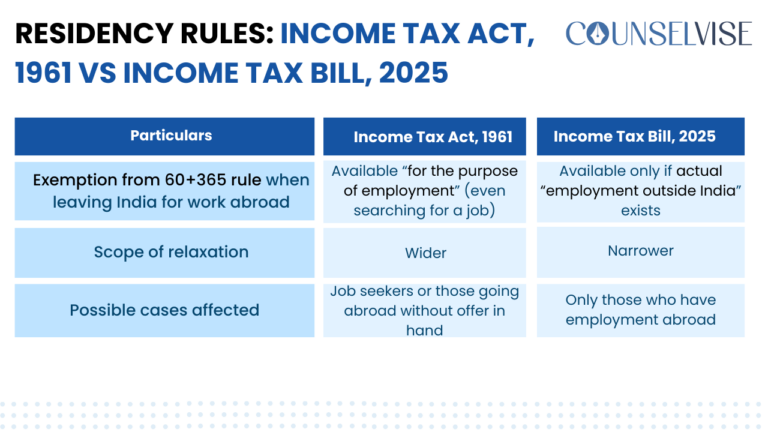
Residency Rules: Income Tax Act, 1961 vs Income Tax Bill, 2025 — A Subtle Yet Significant Shift!

Residential status is one of the most critical factors in determining an individual’s tax exposure in India. For decades, Section 6 of the Income-tax Act, 1961 laid down clear and well-understood rules to decide whether a person qualifies as a Resident or Non-Resident.

With the proposed Income-tax Bill, 2025, while the overall framework remains intact, a subtle but important tightening has been introduced; one that individuals working overseas and tax professionals must not overlook.

What the law said earlier (Income-tax Act, 1961)-

Under Income Tax Act, 1961 an individual was treated as a “Resident” if they:

    • Stayed in India for 182 days or more in a year, or
    • Stayed for 60 days in the year and 365 days in the preceding four years

However, there was a significant relief. If an Indian citizen left India for the purpose of employment abroad, Explanation 1(b) under Section 6 of the Act ( i.e. the 60+365 day condition) did not apply.
In practice, this phrase was interpreted widely; covering even those who went abroad to explore or search for job opportunities.

What changes under the Income-tax Bill, 2025-

The proposed Bill narrows this relief.

The exemption from the 60+365 day rule now applies only when:

    • A person leaves India as a crew member of an Indian ship, or
    • Leaves India for actual employment outside India

The earlier, broader phrase “for the purpose of employment” has been consciously replaced. This linguistic shift materially raises the bar.

Why this matters in real life

    • Earlier, individuals going abroad without a confirmed job could still claim Non-Resident status.
    • Going forward, mere job hunting abroad may not suffice.
    • Without proof of overseas employment, individuals may end up being classified as Residents, triggering taxation of global income in India, and Increased reporting and compliance obligations.

Closing thoughts

What appears to be a minor drafting change is, in reality, a policy-driven tightening of residency norms. The objective is to prevent the misuse of Non-Resident status based solely on temporary overseas movement without substantive employment.

Professionals, NRIs, and consultants planning to move abroad for career opportunities should carefully evaluate this change and plan accordingly.